Why Your Profit Says $4,000 and Your Bank Says $900
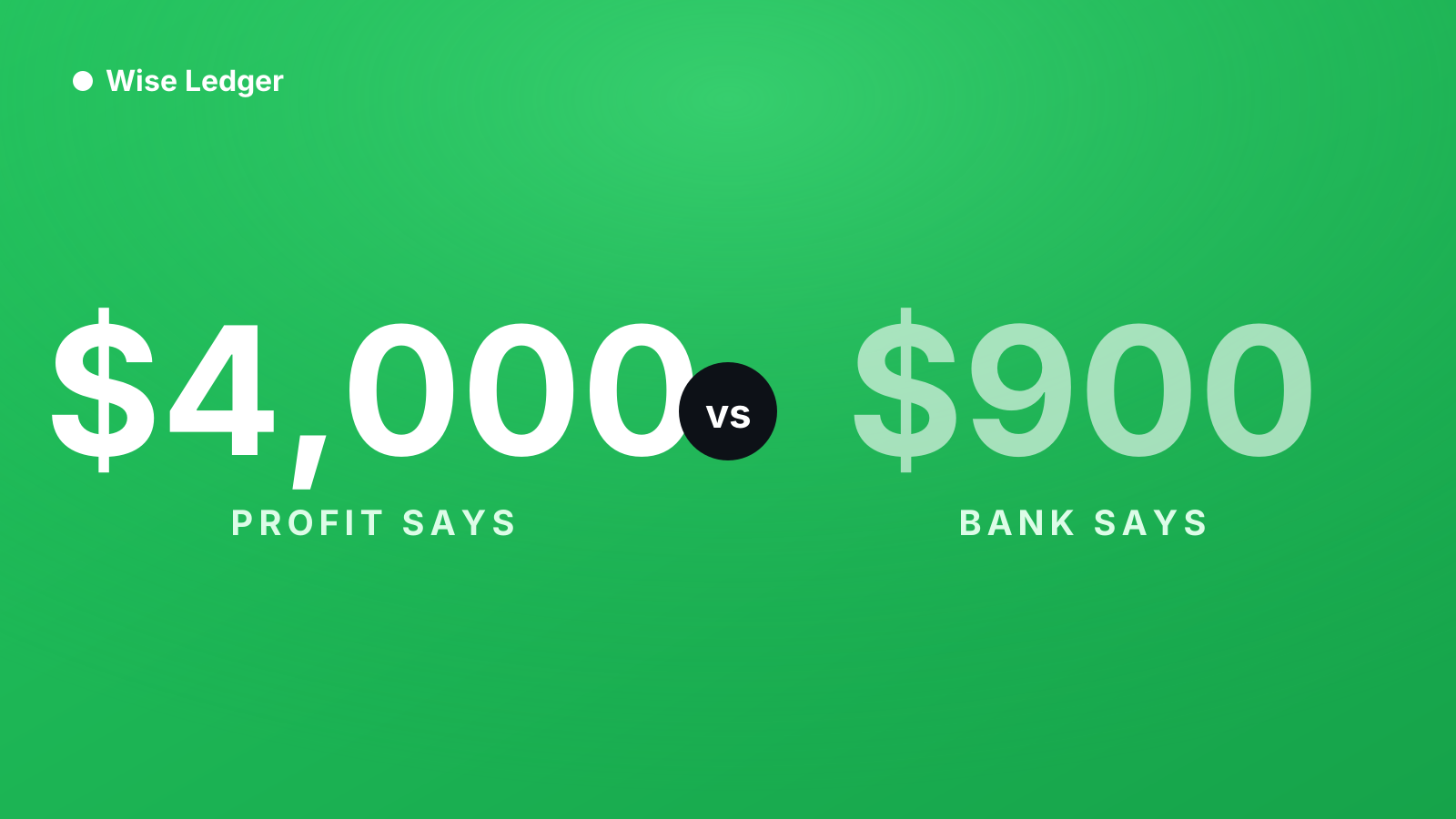
You finish the month, open your accounting app, and it tells you that you made $4,000.
Then you open your banking app. $900.
Nothing has been stolen. Your app isn’t broken. But one of those numbers is describing a business you don’t actually have yet — and if you plan around the wrong one, you’ll run out of money while your reports insist you’re doing fine.
Here’s what’s happening.
The two ways to count money
Every accounting system has to decide when a sale counts as income. There are two answers, and they produce wildly different pictures of the same month.
Accrual accounting counts income the moment you send the invoice. You did the work, you billed for it, it’s income — whether or not anyone has paid you.
Cash-basis accounting counts income the moment the money arrives. An unpaid invoice is a promise, not income.
Most accounting software defaults to accrual, because that’s how corporations and larger businesses are required to report. If you’re a freelancer or sole proprietor, that default is quietly working against you.
What that looks like in a real month
Say you invoiced three clients in March:
| Client | Invoiced | Paid? |
|---|---|---|
| A | $2,000 | Paid March 14 |
| B | $1,500 | "Net 30" — arriving in April |
| C | $1,200 | Chased twice, still nothing |
| Total invoiced | $4,700 | |
| Actually received | $2,000 |
Now subtract $800 of real expenses you actually paid — software, travel, that camera lens.
Accrual view: $4,700 − $800 = $3,900 profit. Excellent month.
Cash view: $2,000 − $800 = $1,200. That’s what’s in the bank.
Both numbers are arithmetically correct. Only one of them can pay your rent.
Why this quietly hurts freelancers
For a business with a finance team and a line of credit, accrual is the right lens — it shows what you’ve earned, and the timing gap gets managed.
You don’t have a line of credit. You have a bank balance and a bill due Friday.
You feel richer than you are. A $4,000 “profit” month that delivered $900 in cash still reads as a good month. So you invest, or upgrade, or simply don’t chase the outstanding invoices hard enough. The report told you everything was fine.
Late payers become invisible. On accrual, Client C’s $1,200 was booked as income the day you invoiced. It sits in your profit figure looking exactly like money — for months, if they never pay. Nothing in the report screams that a quarter of your “income” hasn’t arrived.
You can’t spot the pattern. If your profit and your bank balance drift apart month after month, that’s a signal: your payment terms are too generous, or one client is habitually late. Accrual smooths that signal away.
The quarterly-tax version of the same problem
This one costs real money. If you’re self-employed, you owe estimated tax quarterly — and self-employment tax alone runs 15.3% on top of income tax.
Set that aside as a percentage of your accrual profit and you’ll transfer money you don’t have, for income that hasn’t landed. Set it aside from cash actually received and the number is one you can genuinely pay.
Same principle, higher stakes: reserve against money that exists.
The number that actually matters
For most self-employed people, the question isn’t “what did I earn?” It’s “what have I actually got, and what’s still owed to me?”
Those are two separate facts, and you need to see both:
- Real profit — cash in, minus cash out. Money that exists.
- Outstanding — invoiced, not yet paid. Money that’s promised.
Kept apart, they’re useful. One tells you what you can spend; the other tells you who to chase. Blended into one “profit” figure, they hide each other.
How to fix it this week
You don’t need to switch accountants or learn double-entry bookkeeping. Four changes:
1. Switch your reports to cash basis. Most software offers it — it’s usually buried in report settings rather than offered up front. If your app can’t show you cash-basis profit at all, that’s worth knowing.
2. Record the payment, not the invoice. Sending an invoice is a claim. Getting paid is income. Log them as two separate events, on the dates they actually happened.
3. Keep an outstanding list you actually look at. Not buried in a report you open once a quarter — visible enough that a 60-day-old invoice bothers you.
4. Budget against cash, not profit. If you set a monthly spending budget from an accrual profit figure, you’re budgeting against money that hasn’t turned up.
What Wise Ledger does differently
We built Wise Ledger cash-basis first, because that’s the reality of running a small business: income counts when the money lands.
- Record income and expenses as they happen — cash in, cash out, no ambiguity
- Send invoices and record payments as separate events, so an unpaid invoice never masquerades as income
- P&L, Balance Sheet and Cash Flow built from money that actually moved
- Monthly budgets with alerts based on real cash, so your limits mean something
Wise Ledger doesn’t file your taxes and it isn’t a replacement for your accountant. It’s for the part in between: knowing, on any given day, what you’ve actually made and what you’re still owed.
None of this is complicated once you separate the two questions. What you earned and what you’ve got are different facts, and only one of them can pay a bill.
See what you've really made — and what you're still owed.